
About us
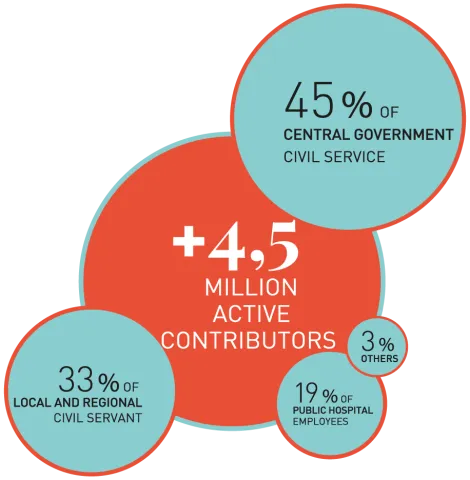
The public sector additional pension scheme (RAFP) is a mandatory, points-based scheme created for fully qualified and trainee civil servants working in French central government (civilians and military), local and regional authorities and the public hospitals sector, as well as members of the judiciary. Thanks to the Scheme, close to 4.5 million contributors benefit from additional pension benefits.
The French public additionnal pension scheme (ERAFP) is the public-sector administrative entity that manages this pension scheme.
Organisation and operation
The RAFP was established by the 2003 pension reform act and has been operational since January 1, 2005.
It enables civil servants to receive a supplementary pension in addition to the benefits paid by the civil service’s basic pension schemes: Caisse nationale de retraite des agents des collectivités locales (CNRACL) or le Service des Retraites de l’État (SRE).
The ERAFP Board of Directors defines the Scheme’s technical parameters on an annual basis. It also sets the general guidelines for the investment policy regarding the Scheme’s reserves.
In particular, ERAPF carries out the Scheme’s financial investments, either in-house or by delegating them to external management firms.

The scheme operates on a funded basis. Each beneficiary has an individual RAFP pension account—accessible via their personal online portal—where their RAFP points accumulate.
Employers report their staff's contributions annually (with the contribution rate split equally between the employee—5%—and the employer—5%), calculated based on supplementary remuneration up to a limit of 20% of the gross base salary.
These contributions are converted into points; when multiplied by the point’s service value, they determine the amount of the benefit received by the employee.
As a state public institution, the ERAFP adheres to the principle of separating the roles of authorizing officer and public accountant. Appointed by the supervising ministers, the Accounting Officer is solely responsible for making payments, collecting revenue, handling funds, and maintaining the ERAFP’s accounts.
Beneficiaries
The RAFP is a mandatory scheme aimed at all fully qualified and trainee civil servants in the three public service functions as well as members of the judiciary.
Who is the RAFP for?
Anyone who is a :
- civil servant, including on secondment;
- a member of the judiciary;
- a member of the military, whether permanent, under contract or a reservist...
... and who receives ancillary remuneration (bonuses, allowances, in-kind benefits, etc.) that the basic public service schemes do not take into account, contributes to the Scheme.
The following are excluded:
- local employees of territorial authorities or public hospitals in French overseas collectivities,
- civil servants with disponibilité (available) or hors cadres (expatriate) status,
- fully qualified civil servants who work fewer than 28 hours a week.
SRI values and financial management
The Scheme’s management has been entrusted by decree to Établissement de retraite additionnelle de la fonction publique (ERAFP), a State-supervised public administrative institution.
ERAFP’s core business is to manage the Scheme technically and financially so as to maximise the return on the assets it invests, which will form the basis of contributors’ future pension income once they reach their additional pension liquidation age.
Governed by the prudential rules strictly defined in the Decree of June 18, 2004, this management approach makes it possible to maintain a coverage ratio of at least 100% (Art. 28 of the Decree of June 18, 2004).
By its nature, ERAFP is therefore dedicated to the public interest and, in particular, highly attuned to social issues. Accordingly, as soon as it was created in 2005, it put in place an innovative and ambitious programme to implement a socially responsible investment (SRI) policy founded on public service values. This policy takes into account environmental, social and governance criteria in each of the Scheme’s investments.
As the only French public pension fund, ERAFP seeks to demonstrate that investors can serve the public interest without forgoing the financial return on their investments. It has thus targeted three specific areas for investment: the fight against climate change, support for economic activity and financing affordable housing for public sector employees.
It excludes from its investment universe all areas prohibited by the laws of the Republic or by international conventions ratified by France.
Apart from the aforementioned exclusions, and as a major institutional investor, ERAFP invests across all economic sectors and asset classes, employing a "best-in-class" approach.


